
Masters in Ireland for Indian Students
Table of Contents
- Top Universities for Masters in Ireland
- Course Structure of Masters in Ireland
- Eligibility Requirements for Masters in Ireland
- Cost of Studying Masters in Ireland
- Top Scholarships for Masters in Ireland
- Masters in Ireland Intakes and Admission Deadlines
- How to Apply for Masters in Ireland
- Student Visa Requirements for Masters in Ireland
- Popular Cities for Masters in Ireland
- Post-Study Work Opportunities After Masters in Ireland
- Top Job Opportunities After Masters in Ireland
- Conclusion
Masters in Ireland takes about1–2 years of study, with most English taught master programs completed in just one year. Tuition fees ranges between €10,000–€35,000 per year (₹10 lakh–₹35 lakh). Indian students get to work for up to 20 hours per week during academic sessions and qualify for a 2-year post-study work visa under the Third Level Graduate Programme after completing a Level 9 masters degree. Study in Ireland is popular for it’s globally recognized academic excellence, industry partnerships and strong graduate employability, making the country a leading destination for postgraduate education.
Masters in Ireland: Key Highlights
Particulars | Details |
Degree Level | Postgraduate (Masters) |
Duration | 1–2 Years (Most taught programs: 1 Year) |
Language of Instruction | English |
Approximate Tuition Fees | €10,000–€35,000 (₹10 lakh–₹35 lakh) |
Approximate Living Costs | €12,000–€18,000/year (₹12 lakh–₹18 lakh) |
Work Rights During Study | 20 Hours/Week During Semester |
Work Rights During Holidays | 40 Hours/Week |
Post-Study Work Visa | Up to 2 Years |
Major Intakes | September, January |
Visa Type | Irish Stamp 2 Student Permission |
Top Student Cities | Dublin, Cork, Galway, Limerick |
Popular Fields | Business, Data Science, AI, Finance, Engineering, Healthcare |
Top Recruiters | Google, Microsoft, Meta, Pfizer, Deloitte, Accenture |
This article provides information on Masters in Ireland, including top universities, admission requirements, tuition fees, scholarships, living expenses, student visa requirements, post-study work opportunities and career prospects for Indian students.
Top Universities for Masters in Ireland
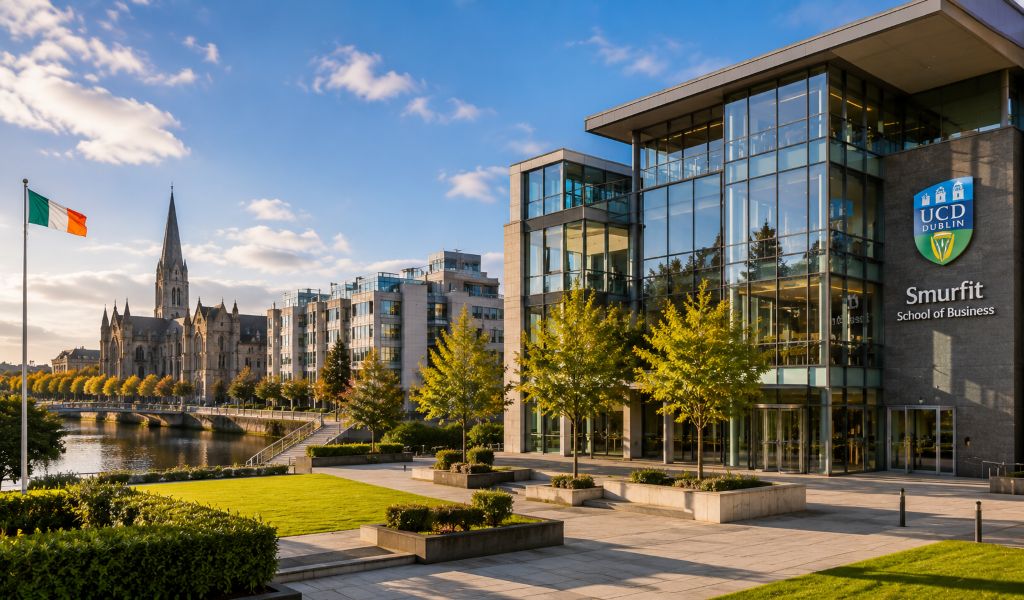
Ireland's two highest-ranked universities, Trinity College Dublin and University College Dublin, continue to strengthen their global reputation. Home to many globally ranked universities known for research excellence, industry engagement and graduate employability.
The table below highlights leading universities for pursuing masters degree in Ireland based on the latest QS World University Rankings 2027:
University | QS World University Rankings 2027 | Approx. Annual Tuition Fee |
Trinity College Dublin | #75 | €14,000–€35,000 (₹14 lakh–₹35 lakh) |
University College Dublin | #100 | €16,000–€30,000 (₹16 lakh–₹30 lakh) |
University College Cork | #220 | €15,000–€28,000 (₹15 lakh–₹28 lakh) |
University of Galway | #275 | €15,000–€25,000 (₹15 lakh–₹25 lakh) |
University of Limerick | #388 | €14,000–€25,000 (₹14 lakh–₹25 lakh) |
Dublin City University | #408 | €13,000–€22,000 (₹13 lakh–₹22 lakh) |
Note: Actual tuition costs may differ based on the chosen specialization, study duration, and university updates.
Course Structure of Masters in Ireland
Masters in Ireland programs provide advanced academic knowledge and prepare students with practical industry skills in specialized fields. Most of the masters programs run a mix of lectures, seminars, projects, research assignments and industry focused assessments.
The table below outlines the structure of masters program in Ireland:
Study Component | Course Structure |
Core Modules | Subject-specific advanced coursework |
Elective Modules | Specialized areas of interest |
Practical Learning | Industry projects, case studies, labs |
Research Component | Dissertation or thesis |
Industry Engagement | Internships, guest lectures, networking events |
Final Assessment | Dissertation, project or capstone assignment |
Eligibility Requirements for Masters in Ireland
Students are required to demonstrate academic competence, English language proficiency and program-specific qualifications. However, Admission requirements depend on the university and program.
The tables below highlight some common admission requirements:
Academic Requirements for Masters in Ireland:
Requirement | Details for Indian Students |
Bachelor's Degree | 3 or 4 year recognized bachelors degree from a UGC/AICTE-recognized institution |
Minimum Academic Score | Min. of 60%–70% or equivalent CGPA; top universities often prefer First Class or Upper Second-Class equivalent qualifications |
Relevant Academic Background | Degree should be related to the intended master's specialization |
Backlogs | Some universities accept limited backlogs if overall academic performance is strong |
Work Experience | Usually not required for MS programs but preferred for MBA and management courses |
Statement of Purpose (SOP) | Required to explain academic background, career goals and motivation |
Letters of Recommendation | 1–2 academic or professional references |
Resume/CV | Required for most postgraduate applications |
Entrance Exam Requirements for Masters in Ireland:
Examination | Requirement |
GMAT | May be required or recommended for MBA, Finance, and Management programs |
GRE | Occasionally required for selected STEM, Economics, and research-intensive programs |
Portfolio Assessment | Common for Design, Architecture, and Creative Arts programs |
Interview | May be conducted for MBA, Healthcare, Education and highly competitive courses |
English Language Requirements for Masters in Ireland:
Test | Typical Requirement |
IELTS Academic | Overall 6.5, usually with no band below 6.0 |
TOEFL iBT | 88–100 |
PTE Academic | 63–65 |
Duolingo English Test | Accepted by selected universities |
Cambridge English | Accepted by many institutions |
Note: Programs such as Data Science, Artificial Intelligence, Finance, Business Analytics, Computer Science and MBA have stricter entry requirements and higher academic expectations than the minimum eligibility criteria. Always verify program-specific requirements directly with the university before applying.
Cost of Studying Masters in Ireland
The total cost of studying in Ireland includes tuition fees and living expenses. Dublin is generally the most expensive city, students can also find more affordable living options in cities like Galway, Cork and Limerick.
The table below outlines tuition fees:
University Category | Approx Tuition Fee |
Public Universities | €10,000–€25,000 (₹10 lakh–₹25 lakh) |
Business & Finance Programs | €18,000–€35,000 (₹18 lakh–₹35 lakh) |
STEM Programs | €12,000–€30,000 (₹12 lakh–₹30 lakh) |
Specialized Professional Degrees | €20,000–€35,000 (₹20 lakh–₹35 lakh) |
The table below outlines annual living expenses.
Expense Category | Approximate Annual Cost |
Accommodation | €6,000–€10,000 (₹6 lakh–₹10 lakh) |
Food & Groceries | €2,000–€3,500 (₹2 lakh–₹3.5 lakh) |
Transportation | €800–€1,500 (₹80,000–₹1.5 lakh) |
Utilities | €1,000–€1,500 (₹1 lakh–₹1.5 lakh) |
Miscellaneous Expenses | €2,000–€3,500 (₹2 lakh–₹3.5 lakh) |
Top Scholarships for Masters in Ireland
Ireland offers several scholarships for Indian students through government initiatives and university funding programs. The Government of Ireland International Education Scholarship provides a full tuition fee waiver along with a €10,000 stipend (₹10 lakh) for living expenses. University-specific awards such as the UCD Global Excellence Scholarship can cover up to 100% of tuition fees. Students enrolled in eligible Erasmus Mundus programs may receive comprehensive funding that includes tuition fees, living expenses, travel costs and health insurance, making it one of the most valuable scholarship opportunities in Europe.
The table below highlights the most popular scholarships for Indian students pursuing Masters in Ireland:
Scholarship | Eligibility | Coverage |
Government of Ireland International Education Scholarship (GOI-IES) | Outstanding non-EU students with an offer from an eligible Irish university | Full tuition fee waiver + €10,000 stipend (₹10 lakh) for one academic year (University College Dublin) |
UCD Global Excellence Scholarship | International students admitted to eligible postgraduate programs at University College Dublin | 50% or 100% tuition fee scholarship (University College Dublin) |
Trinity College Dublin Global Excellence Scholarship | High-achieving international postgraduate applicants | Partial to substantial tuition fee reduction |
University of Galway International Student Scholarships | International students with excellent academic records | Tuition fee discounts ranging from partial to significant reductions |
University College Cork Merit Scholarships | Strong academic performance and admission offer holders | Partial tuition fee waivers |
Dublin City University Merit Scholarships | International postgraduate students with strong academic achievements | Tuition fee reduction |
Maynooth University International Scholarships | High-performing international students | Partial tuition fee support |
Erasmus Mundus Joint Masters Scholarship | Students admitted to Erasmus-approved joint master's programs | Full tuition fees, travel costs, insurance, and living stipend |
Irish Research Council Scholarships | Research-based master's and postgraduate students | Research funding and financial support |
Hardiman Scholarship (University of Galway) | Exceptional postgraduate researchers | Tuition support and stipend (primarily research-focused) |
Masters in Ireland Intakes and Admission Deadlines
Masters in Ireland programs start their intakes in September and January, with September being the largest intake across universities. Most postgraduate programs admit majority of international students during the September intake as it provides greater course availability, scholarship opportunities and internship access.
The table below highlights the admission cycles for Masters in Ireland:
Intake | Application Period | Program Start |
September Intake | October – June | September |
January Intake | June – November | January |
Rolling Admissions (Selected Programs) | Varies by University | Multiple Start Dates |
Students should submit applications, 6–10 months before the intended intake to improve admission and scholarship prospects.
How to Apply for Masters in Ireland
Application process for Masters in Ireland is relatively straightforward, it still requires careful planning and documentation. Universities assess applicants based on academic performance, English language proficiency, program suitability and professional achievements.
Step 1: Research Masters in Ireland Programs
Identify universities and programs that align with your academic background, career goals, budget and preferred location.
Note: Compare rankings, tuition fees, curriculum structure, industry connections and scholarship opportunities before finalizing their shortlist.
Step 2: Review Admission Requirements
Each university have specific eligibility criteria regarding academic qualifications, prerequisite subjects, work experience and English language proficiency. Reviewing these requirements early helps avoid delays during application submission.
Step 3: Complete English Language Tests
Most international applicants are required to submit IELTS, TOEFL, PTE Academic or Duolingo English Test scores. Students should aim to meet the university's minimum score requirements.
Step 4: Prepare Supporting Documents
Gather all required documents including academic transcripts, degree certificates, passport copies, statement of purpose, letters of recommendation, resume/CV and language proficiency scores.
Step 5: Submit Online Applications
Complete the university application portal, upload supporting documents, pay the application fee if applicable and submit the application before the official deadline.
Step 6: Accept Offer Letter
Successful applicants receive either a conditional or unconditional offer. Students must accept the offer and pay any required tuition deposit to secure their place.
Step 7: Apply for Student Visa
After confirming admission, students should arrange finances, obtain health insurance where required and begin the Irish student visa application process.
Student Visa Requirements for Masters in Ireland
International students from non-EU/EEA countries pursuing Masters in Ireland need to obtain a long-stay D Study Visa before travelling. Upon arrival, students must also register with Irish immigration authorities and obtain residence permission.
The table below outlines the key visa requirements for Masters in Ireland.
Requirement | Details |
University Offer Letter | Official admission confirmation from an Irish institution |
Valid Passport | Valid for the entire duration of study |
Tuition Fee Payment Proof | Evidence of paid tuition deposit or fees |
Proof of Financial Capacity | Sufficient funds to support studies and living expenses |
English Language Proficiency | IELTS, TOEFL, PTE, or accepted equivalent |
Academic Documents | Degree certificates and transcripts |
Visa Application Form | Completed online visa application |
Passport-Sized Photographs | As per Irish visa specifications |
Private Medical Insurance | Required for international students |
Statement of Purpose | Study intentions and future career plans |
Financial Requirements for Masters in Ireland Student Visa
Students must demonstrate adequate financial resources to support themselves while studying. The below table outlines these reuirements:
Expense Type | Approximate Requirement |
Living Expenses | €10,000–€12,000 annually (₹10 lakh–₹12 lakh) |
Tuition Fees | As specified by university offer letter |
Emergency Funds | Additional financial evidence may be requested |
Popular Cities for Masters in Ireland
Choosing the right city influences your student experience, internship opportunities, networking exposure and employment prospects after graduation. Ireland's major cities host multinational companies, research centers and thriving startup ecosystems.
The table below highlights the best cities for pursuing Masters in Ireland.
City | Advantages for International Students |
Dublin | Ireland's largest employment hub with headquarters of Google, Meta, Microsoft, LinkedIn, TikTok, and major financial institutions |
Cork | Strong pharmaceutical, biotechnology, and technology sectors with comparatively lower living costs |
Galway | Major center for medical technology, healthcare innovation, and research-driven industries |
Limerick | Growing engineering, manufacturing, and technology employment opportunities |
Waterford | Emerging technology ecosystem with affordable student living options |
Maynooth | Popular student town near Dublin with lower accommodation costs and strong academic environment |
Post-Study Work Opportunities After Masters in Ireland
Major advantages of pursuing Masters in Ireland is the fact that the country's favorable post-study work policy allows graduates with a Level 9 masters qualification to stay up to 2 years under the Third Level Graduate Programme to for employment.
This pathway allows international graduates to gain valuable work experience, transition into long-term employment and can pursue future residency opportunities.
The table below outlines post-study work benefits.
Category | Details |
Eligible Qualification | Level 9 Masters Degree |
Post-Study Work Duration | Up to 2 Years |
Employment Restrictions | No sponsorship required during graduate period |
Full-Time Work Rights | Allowed |
Pathway to Critical Skills Employment Permit | Available |
Potential Route to Long-Term Residency | Possible through employment-based immigration pathways |
Top Job Opportunities After Masters in Ireland
Ireland's economy is heavily driven by technology, pharmaceuticals, healthcare, financial services, engineering and professional consulting sectors. Graduates from Irish universities benefit from strong employer demand and access to multinational corporations operating across Europe.
The table below highlights popular career opportunities available after completing Masters in Ireland:
Job Role | Approx Annual Salary | Top Recruiters |
Data Analyst | €40,000–€65,000 (₹40 lakh–₹65 lakh) | Google, Accenture, Deloitte |
Software Engineer | €45,000–€80,000 (₹45 lakh–₹80 lakh) | Microsoft, Amazon, Meta |
Financial Analyst | €40,000–€70,000 (₹40 lakh–₹70 lakh) | JPMorgan, Citi, EY |
Business Analyst | €42,000–€75,000 (₹42 lakh–₹75 lakh) | PwC, KPMG, Deloitte |
Pharmaceutical Scientist | €45,000–€80,000 (₹45 lakh–₹80 lakh) | Pfizer, Johnson & Johnson |
AI & Machine Learning Engineer | €50,000–€90,000 (₹50 lakh–₹90 lakh) | Intel, IBM, Google |
Cybersecurity Analyst | €45,000–€85,000 (₹45 lakh–₹85 lakh) | Mastercard, Dell, Accenture |
Supply Chain Manager | €50,000–€90,000 (₹50 lakh–₹90 lakh) | Amazon, PepsiCo, Kerry Group |
Conclusion
Masters in Ireland offers international students a unique combination of globally recognized education, shorter program durations, strong industry integration, and excellent post-study work opportunities. With most masters programs completed in just one year, students can enter the workforce quickly while minimizing overall education costs compared to many other study destinations.
Ireland's thriving technology, pharmaceutical, financial services, and engineering sectors continue to attract multinational employers seeking highly skilled graduates. Combined with a two-year post-study work visa, strong graduate employability, and access to the European job market, Masters in Ireland remains one of the most attractive postgraduate study options for international students.
If you are considering pursuing a masters degree abroad, Ireland provides an excellent balance of academic quality, career growth, and long-term professional opportunities. Have more questions? Book a free 1:1 counselling session with our study abroad experts today and find the best universities, scholarships and career pathways for your future.