Masters in France for Indian Students
Table of Contents
- Why Study Masters in France
- Types of Institutions for Masters in France
- Top Universities for Masters in France
- Popular Courses for Masters in France
- Admission Requirements for Masters in France
- Documents Required for Masters in France
- Cost of Studying Masters in France
- Scholarships for Masters in France
- Masters in France Intakes and Admission Deadlines
- How to Apply for Masters in France
- Best Cities for Masters in France
- Job Opportunities After Masters in France
- Top Recruiters After Masters in France
- Conclusion
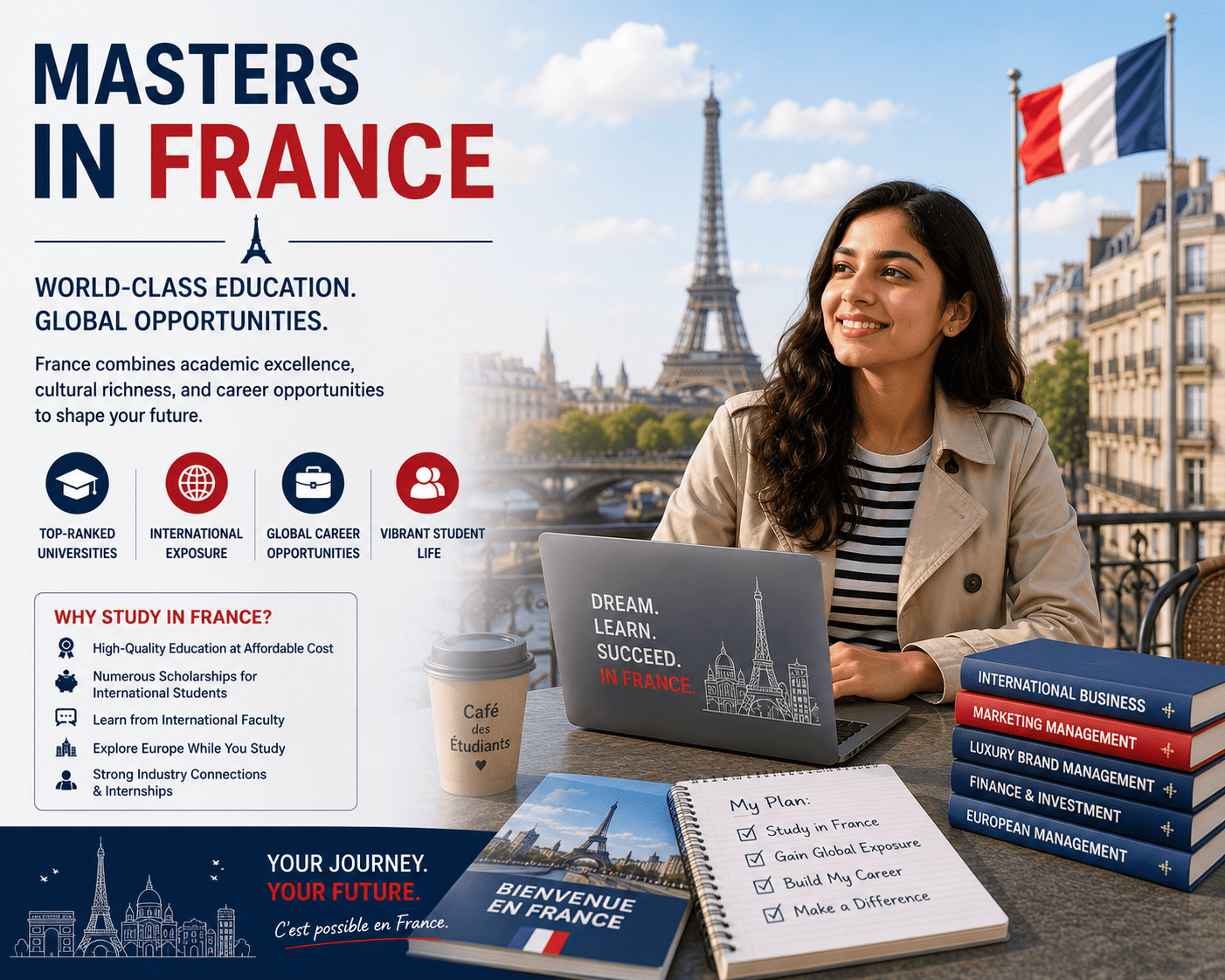
France is one of Europe's leading destinations for postgraduate education, welcoming over 400,000 international students annually. Masters in France offers globally recognized qualifications, affordable tuition fees, research-driven learning, and access to the European job market. Masters in France costs between EUR 243 to EUR 3,770 annually at public universities (approximately ₹23,000 to ₹3.7 lakh), while private business schools can cost up to EUR 25,000 (approximately ₹24.5 lakh) per year. Most master's degrees in France are completed within two years and provide students with access to one of Europe's largest economies.
The table below provides a quick overview of Masters in France.
Particulars | Details |
Degree Level | Master's (M1 + M2) |
Duration | 2 Years |
Language of Instruction | English & French |
Popular Intakes | September, January |
IELTS Requirement | 6.0–7.0 |
Tuition Fees at Public Universities | EUR 3,770 per year (₹3.7 lakh) |
Tuition Fees at Private Institutions | EUR 10,000–30,000 (₹9.5 lakh–₹28.5 lakh) |
Living Expenses | EUR 9,000–15,000 annually (₹8.5 lakh–₹14.2 lakh) |
Post-Study Work Permit | Up to 24 Months |
Top Fields | Business, Engineering, Data Science, AI, Luxury Management |
Average Graduate Salary | EUR 35,000–60,000 (₹33.2 lakh–₹57 lakh) |
This blog provides all information students need about pursuing a Masters in France, including the French higher education system, top universities, eligibility requirements, tuition fees, scholarships, student visa requirements, admission process and career opportunities. You can also read about Studying in France.
Why Study Masters in France
France is an attractive destination for thousands of students as their Masters programme offer premium education, affordable tuition structure and strong employment opportunities. Students get advantage as French universities emphasize research, innovation and practical learning while offering them access to European and global job markets.
Key advantages of pursuing a Masters in France include:
Globally recognized universities and Grandes Écoles
Affordable public university tuition fees
More than 1,700 English-taught master's programs
Strong focus on research and innovation
Opportunities to work while studying
Access to the European Union job market
Post-study work opportunities after graduation
High quality of life and cultural diversity
Education System for Masters in France
The French higher education is structured around Bachelors, Masters and Doctoral programs. Masters education focuses on advanced specialization, research skills and industry relevant learning. Students generally complete 120 ECTS credits during a masters degree. The standardized European credit system makes French qualifications widely recognized across Europe and internationally.
The table below provides an overview of the French higher education structure.
Qualification | Duration | ECTS Credits |
Licence (Bachelor's) | 3 Years | 180 ECTS |
Master (M1 + M2) | 2 Years | 120 ECTS |
Doctorate (PhD) | 3–5 Years | Research-Based |
Post-Study Work Opportunities After Masters in France
One of the major advantages of pursuing Masters in France is the opportunity to remain in the country after graduation and explore employment opportunities. International graduates can apply for temporary residence permits that allow them to seek employment, gain professional experience, and potentially transition into long-term work authorization. France continues to attract international talent by offering pathways that support graduates in building careers within the country and across Europe.
The table below highlights common post-study opportunities.
Opportunity | Details |
Temporary Residence Permit | Up to 24 Months |
Part-Time Work During Studies | Up to Permitted Hours |
Graduate Employment Pathway | Available |
EU Career Mobility | Supported Through EU Recognition |
Long-Term Residence Options | Available After Eligibility Requirements |
Types of Institutions for Masters in France
Students pursuing Masters in France have to choose between public universities, Grandes Écoles and specialized institutions. Each institution type offers unique advantages depending on academic goals and career aspirations.
The table below compares institution types.
Institution Type | Key Features |
Public Universities | Affordable Tuition, Research Focus |
Grandes Écoles | Highly Selective, Strong Industry Connections |
Business Schools | Global Business Education |
Engineering Schools | Specialized Technical Programs |
Specialized Institutes | Focused Professional Education |
Top Universities for Masters in France
France consistently performs well in global university rankings, particularly in engineering, business, science and technology disciplines. Prestigious universities like Grandes Écoles maintain strong partnerships with employers, research institutions and multinational corporations. Students pursuing Masters in France gain access to internationally recognized qualifications and extensive professional networks. The table below highlights leading universities for Masters in France.
University | QS World University Rankings 2026 | Approximate Tuition Fees |
PSL University | #28 | EUR 3,770–20,000 (₹3.7 lakh–₹19 lakh) |
Institut Polytechnique de Paris | #41 | EUR 3,770–18,000 (₹3.7 lakh–₹17.1 lakh) |
Sorbonne University | #72 | EUR 3,770–15,000 (₹3.7 lakh–₹14.2 lakh) |
Université Paris-Saclay | #73 | EUR 3,770–16,000 (₹3.7 lakh–₹15.2 lakh) |
École Normale Supérieure de Lyon | #187 | EUR 3,770–12,000 (₹3.7 lakh–₹11.4 lakh) |
Grenoble Alpes University | #334 | EUR 3,770–10,000 (₹3.7 lakh–₹9.5 lakh) |
emlyon Business School | Global Business School | EUR 18,000–32,000 (₹17.1 lakh–₹30.4 lakh) |
ESSEC Business School | Global Business School | EUR 20,000–35,000 (₹19 lakh–₹33.2 lakh) |
EDHEC Business School | Global Business School | EUR 18,000–30,000 (₹17.1 lakh–₹28.5 lakh) |
HEC Paris | Global Business School | EUR 25,000–45,000 (₹23.7 lakh–₹42.7 lakh) |
Popular Courses for Masters in France
France offers wide range of disciplines that cater to global industry demands adopting to digital transformation and sustainability focused strategies. Students can choose from a range of industries like technology, business, engineering, healthcare, sustainability and creative fields based on their academic and career objectives. The table below highlights popular master's courses.
Course | Popular Specializations | Approximate Tuition Fees |
Business & Management | Finance, Marketing, International Business | EUR 10,000–35,000 (₹9.5 lakh–₹33.2 lakh) |
Engineering | Mechanical, Civil, Electrical | EUR 3,770–18,000 (₹3.7 lakh–₹17.1 lakh) |
Data Science | AI, Machine Learning, Analytics | EUR 8,000–25,000 (₹7.6 lakh–₹23.7 lakh) |
Computer Science | Software Engineering, Cybersecurity | EUR 8,000–20,000 (₹7.6 lakh–₹19 lakh) |
Luxury Management | Fashion, Hospitality, Luxury Brands | EUR 15,000–35,000 (₹14.2 lakh–₹33.2 lakh) |
Public Health | Healthcare Management | EUR 5,000–15,000 (₹4.7 lakh–₹14.2 lakh) |
International Relations | Diplomacy, Global Affairs | EUR 5,000–18,000 (₹4.7 lakh–₹17.1 lakh) |
Admission Requirements for Masters in France
Universities offering Masters in France evaluate applicants based on academic performance, language proficiency, supporting documents, and program-specific requirements. Requirements may vary between public universities and competitive Grandes Écoles. Students should carefully review individual university criteria before applying.
Eligibility Criteria for Masters in France
The table below summarizes typical eligibility requirements.
Requirement | Typical Criteria |
Bachelor's Degree | Required |
Minimum Academic Score | 60–75% or Equivalent |
Relevant Academic Background | Preferred |
Work Experience | Optional for Most Programs |
Statement of Purpose | Required |
Letters of Recommendation | Usually Required |
English Language Requirements for Masters in France
Most English-taught master's programs require proof of English proficiency from international students.
The table below highlights common score requirements.
Test | Minimum Score |
IELTS Academic | 6.0–7.0 |
TOEFL iBT | 80–100 |
PTE Academic | 58–70 |
Duolingo English Test | Accepted by Selected Universities |
Documents Required for Masters in France
Students applying for Masters in France must submit a range of academic and supporting documents that help universities evaluate their academic qualifications, language proficiency, and overall suitability for postgraduate study. Preparing these documents in advance can help streamline the application process and avoid delays during admission review.
The table below highlights the commonly required documents for Masters in France applications.
Document | Purpose |
Academic Transcripts | Verification of Previous Academic Performance |
Bachelor's Degree Certificate | Proof of Qualification |
Statement of Purpose (SOP) | Academic and Career Objectives |
Letters of Recommendation (LORs) | Academic or Professional Assessment |
Resume/CV | Academic and Professional Background |
Valid Passport | Identity Verification |
English Language Test Scores | Proof of Language Proficiency |
Passport-sized Photographs | Application and Visa Requirements |
Portfolio (for Design Courses) | Demonstration of Creative Skills |
Work Experience Documents (if applicable) | Professional Background Verification |
Cost of Studying Masters in France
Cost of pursuing Masters in France consists of tuition fees and living expenses. Compared to many other popular study destinations, France offers relatively affordable public university education while maintaining high academic standards. Students should evaluate both tuition and living costs before finalizing their university choices.
Tuition Fees for Masters in France
Tuition fees vary depending on whether students enroll in public universities, Grandes Écoles or private institutions. Public universities generally offer the most affordable education options for international students. The table below compares approximate tuition fee ranges.
Institution Type | Approximate Annual Tuition Fees |
Public Universities | EUR 3,770 (₹3.7 lakh) |
Engineering Schools | EUR 5,000–18,000 (₹4.7 lakh–₹17.1 lakh) |
Business Schools | EUR 15,000–45,000 (₹14.2 lakh–₹42.7 lakh) |
Private Institutions | EUR 10,000–30,000 (₹9.5 lakh–₹28.5 lakh) |
Cost of Living for Masters in France
Living expenses in France depend on the city, accommodation type and personal lifestyle. Paris is generally the most expensive city, while destinations such as Lille, Grenoble, Toulouse and Nantes offer affordable living costs. Students should budget carefully to ensure comfortable living throughout their studies.
The table below outlines approximate annual living expenses.
Expense Category | Approximate Annual Cost |
Accommodation | EUR 4,500–9,000 (₹4.2 lakh–₹8.5 lakh) |
Food & Groceries | EUR 2,000–3,500 (₹1.9 lakh–₹3.3 lakh) |
Transportation | EUR 400–900 (₹38,000–₹85,000) |
Health Insurance | EUR 300–700 (₹28,000–₹66,000) |
Utilities & Internet | EUR 600–1,200 (₹57,000–₹1.1 lakh) |
Personal Expenses | EUR 1,500–3,000 (₹1.4 lakh–₹2.8 lakh) |
Total Approximate Cost | EUR 9,000–15,000 (₹8.5 lakh–₹14.2 lakh) |
Scholarships for Masters in France
Several scholarship opportunities are available to international students pursuing Masters in France. These scholarships are offered by the French government, universities, business schools, and international organizations to support talented students financially. Applying for scholarships early can significantly reduce the overall cost of studying in France.
The table below highlights major scholarships available for international students.
Scholarship | Eligibility | Coverage |
Eiffel Excellence Scholarship | Outstanding International Students | Tuition, Living Expenses, Travel |
Erasmus+ Scholarship | Eligible European Programs | Partial to Full Funding |
Charpak Scholarship | Indian Students | Tuition and Living Support |
Émile Boutmy Scholarship | Sciences Po Applicants | Partial Tuition Coverage |
ENS International Selection Scholarship | High Academic Achievement | Monthly Stipend |
Université Paris-Saclay Scholarship | International Master's Students | EUR 10,000/year (₹9.5 lakh/year) |
HEC Paris Excellence Scholarship | Merit-Based Applicants | Partial Tuition Waiver |
ESSEC Academic Excellence Scholarship | Outstanding Students | Tuition Reduction |
Masters in France Intakes and Admission Deadlines
Most universities offering Masters in France primarily admit students during the September intake. Some institutions also offer limited January intakes for selected programs. Students should begin preparing applications at least 8–12 months before their preferred intake. Early applications often improve scholarship opportunities and admission success rates.
The table below summarizes major admission cycles.
Intake | Application Timeline | Availability |
September Intake | October–June | Most Programs |
January Intake | May–November | Selected Programs |
Rolling Admissions | Varies by Institution | Limited Programs |
How to Apply for Masters in France
Applying for Masters in France involves multiple crucial stages, from selecting a university to obtaining a student visa. Following a structured application process improves admission chances. The below steps help you ease the admission process:
Step 1: Research Universities and Courses
Compare universities based on their rankings, tuition fees, language of instruction and specialization options. Choose programs aligned with your long-term professional goals.
Step 2: Review Eligibility Requirements
Carefully review academic qualifications, language requirements, prerequisite coursework and admission criteria before starting applications.
Step 3: Prepare Language Test Scores
Before applying to English-taught programs, attain IELTS, TOEFL or other accepted language tests. In case you are applying for French taught programs then you need to demonstrate French language proficiency.
Step 4: Gather Supporting Documents
Preparing transcripts, recommendation letters, statements of purpose, passports, resumes and language test scores in advance helps streamline the application process.
Step 5: Submit Applications
Students should complete university application forms accurately and upload all required documents before application deadlines.
Step 6: Apply for Scholarships
Scholarship applications often have separate requirements and deadlines. Students should identify suitable funding opportunities and submit applications alongside university applications.
Step 7: Accept Admission Offer
After receiving admission decisions, students should confirm acceptance, pay required deposits, and complete enrollment formalities.
Step 8: Apply for Student Visa
Students should initiate the France student visa process immediately after receiving their admission letter.
Student Visa Requirements for Masters in France
International students pursuing Masters in France typically require a Long-Stay Student Visa (VLS-TS). This visa allows students to reside in France for the duration of their studies and may permit part-time employment. Submitting complete documentation can help ensure a smooth visa approval process.
The table below outlines key visa requirements.
Requirement | Details |
University Admission Letter | Required |
Valid Passport | Required |
Proof of Financial Resources | Required |
Accommodation Proof | Required |
Passport Photographs | Required |
Health Insurance | Required |
Visa Application Form | Required |
Campus France Approval (for some countries) | Required |
Best Cities for Masters in France
France has several student friendly cities known for excellent universities, vibrant cultural environments, and strong employment opportunities. Students should consider factors such as living costs, university reputation, and job prospects when choosing a city. The city of study can significantly influence both academic experiences and career opportunities.
The table below highlights popular student destinations.
City | Key Advantages | Approximate Annual Living Cost |
Paris | Business & Finance Hub | EUR 12,000–18,000 (₹11.4 lakh–₹17.1 lakh) |
Lyon | Affordable Living and Strong Industry Presence | EUR 9,000–13,000 (₹8.5 lakh–₹12.3 lakh) |
Toulouse | Aerospace and Engineering Opportunities | EUR 8,500–12,000 (₹8 lakh–₹11.4 lakh) |
Grenoble | Technology and Engineering | EUR 8,500–12,000 (₹8 lakh–₹11.4 lakh) |
Lille | Affordable Student Living | EUR 8,000–11,000 (₹7.6 lakh–₹10.4 lakh) |
Nantes | Research & Sciences | EUR 8,000–11,000 (₹7.6 lakh–₹10.4 lakh) |
Job Opportunities After Masters in France
Graduates completing Masters in France gain access to employment opportunities across business, technology, engineering, healthcare, luxury management, finance, and consulting sectors. France's strong economy and multinational employer presence create diverse career pathways for international graduates. The combination of academic excellence and practical industry exposure contributes to strong graduate employability.
The table below highlights popular career paths.
Job Role | Approximate Annual Salary |
Data Scientist | EUR 40,000–65,000 (₹38 lakh–₹61.7 lakh) |
Business Analyst | EUR 38,000–60,000 (₹36.1 lakh–₹57 lakh) |
Software Engineer | EUR 40,000–70,000 (₹38 lakh–₹66.5 lakh) |
Project Manager | EUR 45,000–75,000 (₹42.7 lakh–₹71.2 lakh) |
Financial Analyst | EUR 40,000–65,000 (₹38 lakh–₹61.7 lakh) |
Marketing Manager | EUR 40,000–70,000 (₹38 lakh–₹66.5 lakh) |
Supply Chain Manager | EUR 45,000–75,000 (₹42.7 lakh–₹71.2 lakh) |
Consultant | EUR 50,000–85,000 (₹47.5 lakh–₹80.7 lakh) |
Top Recruiters After Masters in France
Graduates pursuing Masters in France are recruited by leading multinational corporations, technology firms, consulting companies, luxury brands, and financial institutions. Strong university-industry partnerships often facilitate internships and graduate placements.
The table below highlights major recruiters.
Industry | Major Recruiters |
Consulting | Deloitte, EY, PwC, KPMG, Accenture |
Technology | Google, Microsoft, IBM, Capgemini |
Luxury & Fashion | LVMH, Chanel, Hermès, Kering |
Banking & Finance | BNP Paribas, Société Générale, Crédit Agricole |
Aerospace | Airbus, Safran, Thales |
Automotive | Renault, Stellantis, Michelin |
Conclusion
Masters in France combines academic excellence, affordable education, international exposure and strong career prospects. Whether pursuing business, engineering, technology, healthcare or social sciences, France offers a globally respected postgraduate education experience and access to opportunities across Europe and beyond.
Students should carefully evaluate universities, program structures, tuition fees, scholarship options, and career outcomes before applying. A well-planned study strategy can help maximize academic success and long-term career growth.
Want to Pursue Masters in France? Get in touch with us for a free counselling session.
Find Popular Study Abroad Programs from Top Universities